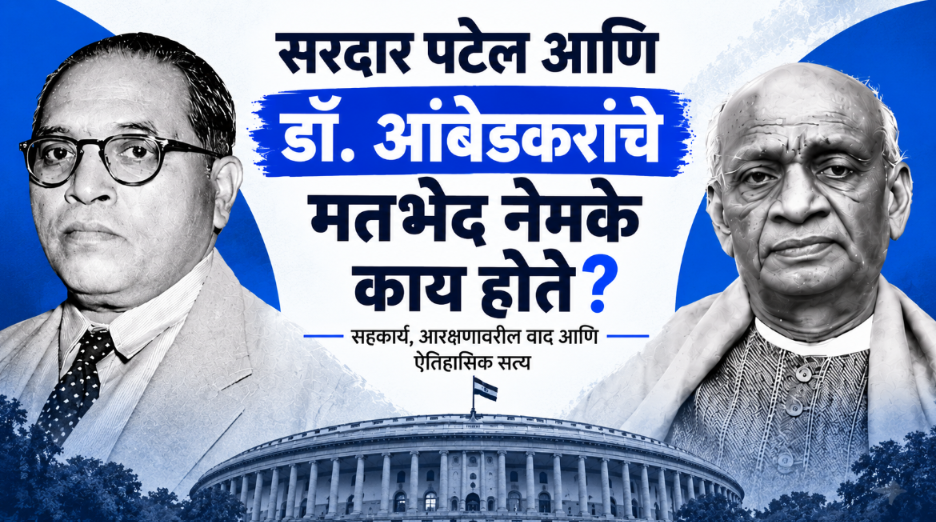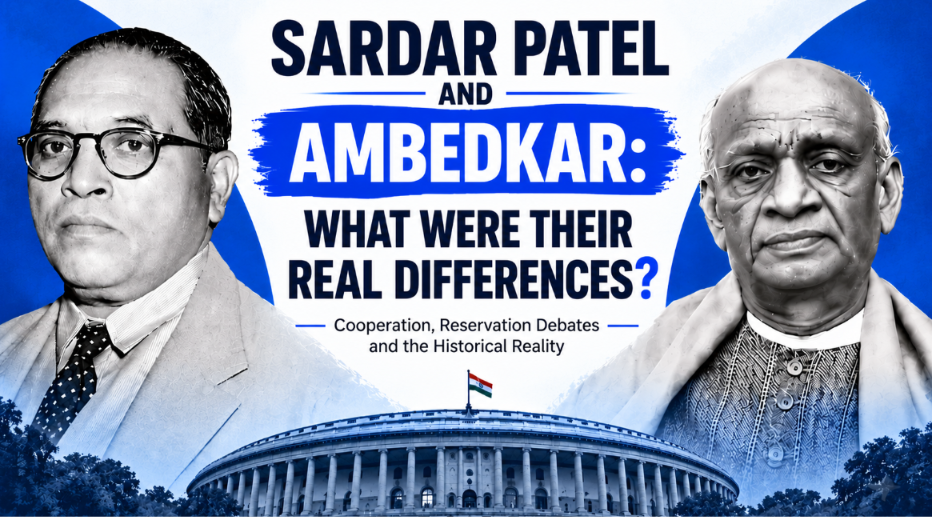
Sardar Vallabhbhai Patel and Dr. B. R. Ambedkar were two influential leaders who played important roles in shaping independent India. Although they differed on certain political questions, particularly the representation of Scheduled Castes, historical records also document Patel’s support for Ambedkar’s return to the Constituent Assembly in 1947. What was the nature of their relationship? Where did their views differ, and what does the historical record tell us?
1. Two Leaders, Two Different Experiences
Dr. B. R. Ambedkar’s public life was shaped by his struggle against caste discrimination, untouchability, and social inequality. He believed that formal equality alone was insufficient to create a just society. Historically disadvantaged communities needed effective political representation, legal safeguards, and constitutional protection to participate meaningfully in democracy.

Ambedkar argued that political democracy could not remain sustainable without social democracy. For him, liberty, equality, and fraternity were essential principles for building a society in which every individual could enjoy equal rights and opportunities.
Sardar Vallabhbhai Patel, meanwhile, was one of the leading figures of the Indian National Congress. He played a significant role in the freedom movement, the integration of princely states, and the administrative consolidation of independent India. Within the Constituent Assembly, Patel also held important responsibilities relating to fundamental rights, minorities, and the administration of tribal areas.
Their political experiences and priorities were not identical. While Ambedkar placed particular emphasis on social justice and safeguards for historically oppressed communities, Patel frequently stressed national integration and a common political framework.
Understanding their relationship therefore requires examining both their cooperation and their disagreements rather than reducing it to a simple story of friendship or conflict.
2. An Important Episode in 1947: Patel’s Support for Ambedkar’s Return to the Constituent Assembly
Dr. Ambedkar was initially elected to the Constituent Assembly from Bengal. However, Partition changed the political and territorial circumstances surrounding his seat, threatening his continued membership in the Assembly at a critical stage of constitution-making.
According to an article published by The Indian Express, based on historical research by Rizwan Qadri, Sardar Patel intervened to facilitate Ambedkar’s return to the Constituent Assembly.
On 1 July 1947 and 3 July 1947, Patel wrote to Dadasaheb Ganesh Vasudev Mavalankar, requesting that he withdraw from an existing vacancy so that Ambedkar could be elected. Patel indicated that arrangements could subsequently be made for Mavalankar’s election to another available seat.
Loading suggested post...
This correspondence is significant because it demonstrates that political differences did not necessarily prevent cooperation. Patel supported Ambedkar’s continued participation in the constitution-making process despite disagreements on certain political questions.
Ambedkar’s contribution to the Constituent Assembly was substantial, and his continued presence became an important part of India’s constitutional history.
The episode should not be interpreted as proof that Patel agreed with all of Ambedkar’s ideas. Rather, it illustrates that the relationship between the two leaders was more complex than a narrative of complete opposition would suggest.
3. Where Did Their Views Differ? Political Representation for Dalits
One of the important areas of disagreement between Ambedkar and Patel concerned the political representation of Scheduled Castes, particularly the question of separate electorates and reserved seats within joint electorates.
Ambedkar was concerned that members of historically oppressed communities might not be able to elect genuinely independent representatives if their political success depended heavily on dominant social groups.
He argued that political representation should give disadvantaged communities an effective voice in legislative institutions. Without adequate safeguards, he feared that representatives from these communities could become dependent on powerful political groups rather than being accountable to the people they were elected to represent.
Patel opposed separate electorates and supported a common electoral framework that included reserved seats for certain communities. His position reflected a concern that separate electoral arrangements could deepen political divisions and weaken the development of a unified political system.
The disagreement was therefore about more than electoral procedure. It raised a fundamental democratic question: How can historically disadvantaged communities secure effective political representation while maintaining a common political framework for all citizens?
Ambedkar emphasised safeguards against social and political domination. Patel placed greater emphasis on political integration and a shared electoral structure. Their positions reflected different assessments of how democracy should function in a society marked by deep social inequalities.
4. Reserved Seats and the Debates of the Constituent Assembly
Patel chaired the Constituent Assembly’s Advisory Committee on Fundamental Rights, Minorities, and related matters. The committee played an important role in considering safeguards for minority communities and the representation of disadvantaged groups.
The committee’s report of 8 August 1947 recommended a system of joint electorates alongside reserved seats for certain communities. The Constituent Assembly discussed these recommendations on 27 and 28 August 1947.
The question of reserved seats remained contentious in subsequent deliberations. Historian Raja Sekhar Vundru, writing in The Indian Express, has discussed Patel’s later position on political reservations. According to this account, Patel proposed removing reserved seats in legislatures towards the end of 1948. Ambedkar opposed the proposal and reportedly warned that removing such safeguards could force him to withdraw from the Assembly’s proceedings.
The subsequent deliberations resulted in the retention of reserved legislative seats for Scheduled Castes.
These developments must be understood within the broader process of constitution-making. The Constitution was not the product of a single leader’s decisions. It emerged through committees, debates, negotiations, and collective decisions involving many members of the Constituent Assembly.
Consequently, it is important to distinguish Patel’s individual position from the final constitutional provisions adopted through the Assembly’s deliberative process.
5. Why Was Ambedkar’s Position Important?
For Ambedkar, political reservation was not simply a question of allocating a certain number of legislative seats. It was connected to the larger challenge of overcoming historical exclusion and ensuring that disadvantaged communities could participate meaningfully in democratic institutions.
He recognised that legal equality was essential but argued that formal equality alone could not automatically eliminate entrenched social inequalities. Political safeguards, constitutional rights, and effective representation were therefore necessary to help historically oppressed communities exercise their democratic rights.
This approach remains relevant to contemporary discussions about social justice, political representation, and affirmative action.
A democracy cannot be evaluated solely by whether elections are conducted regularly. It must also be examined in terms of whether different sections of society have a meaningful opportunity to participate in decision-making. Ambedkar’s insistence on political safeguards emerged from this concern.
His arguments continue to influence debates about representation, equality, and the relationship between democracy and social justice in India.
6. How Should We Understand the Relationship Between Patel and Ambedkar?
The historical relationship between Sardar Patel and Dr. B. R. Ambedkar cannot be accurately described through a single incident or a one-sided narrative.
On certain questions, particularly the form of political representation for Scheduled Castes, their positions differed significantly. Ambedkar emphasised the need for independent political representation and constitutional safeguards, while Patel opposed separate electorates and favoured a common electoral framework with reserved seats.
At the same time, historical accounts document Patel’s intervention in the process that enabled Ambedkar to return to the Constituent Assembly in 1947. Both developments are important to an informed understanding of their relationship.
Political cooperation does not necessarily imply agreement on every issue. Similarly, disagreement on a major constitutional question does not mean that cooperation is impossible in every circumstance.
Patel’s contribution must be assessed in the context of his emphasis on national integration, alongside his positions on political representation. Ambedkar’s contribution must be understood through his sustained struggle for social justice, constitutional safeguards, and the political rights of historically disadvantaged communities.
A balanced historical assessment requires examining their decisions, the arguments behind them, and their consequences.
Conclusion
Sardar Vallabhbhai Patel and Dr. B. R. Ambedkar cooperated on certain matters while holding significant differences on others. Patel’s support for Ambedkar’s return to the Constituent Assembly in 1947 and their disagreements over political representation for Scheduled Castes are both important parts of this history. Neither episode should be ignored when examining their relationship.
Rather than portraying either leader as entirely right or entirely wrong, we should study their actions through historical correspondence, Constituent Assembly debates, committee reports, and credible historical research.
The history of constitution-making is not merely a story of individual leaders. It is also a record of competing ideas, difficult negotiations, and the continuing effort to reconcile national unity with social justice.
Understanding history requires evidence, critical thinking, and a willingness to examine different perspectives while recognising the importance of equality and social justice.
JayBhimTalk | History, Ideas, and Truth
Join our WhatsApp Channel!
Get Dr. Babasaheb Ambedkar's thoughts, historical articles, and latest updates directly on your mobile.
Frequently Asked Questions (FAQs)
Yes, in 1947, when Partition threatened Dr. Ambedkar's seat in the Assembly, Patel wrote to Dadasaheb Mavalankar to facilitate Ambedkar's election in his place.
Their main difference concerned the political representation of Scheduled Castes. Ambedkar favoured separate electorates for independent representation, while Patel emphasized joint electorates with reserved seats.
Following Constituent Assembly debates and Ambedkar's strong insistence, it was decided to retain reserved seats for Scheduled Castes and Tribes in the legislature proportionate to their population.